Subcontractor Risk Engine
& Cyber Safeguards
Protecting General Contractors from jobsite liability, draw wire fraud, and cyber insurance denial.
Get your free compliance risk audit now
About
Evulta protects General Contractors from two of the built environment’s costliest exposures: jobsite insurance claim denial and draw wire fraud. Through our flagship engine, ConstructQC, we automate daily subcontractor license verification and continuous COI defect auditing. In parallel, Evulta delivers Independent Counterparty Risk Intelligence—providing verified due diligence and transaction safeguards so high-value draw payments and cyber insurance warranties remain bulletproof.
Solutions
Protect Your Projects from Liability & Wire Fraud
How It Works
FAQ
No. Evulta and ConstructQC operate with zero disruptive software integrations or IT overhead. We work strictly from client-provided vendor rosters, billing pay-applications, or monthly CSV and spreadsheet exports. You never have to grant direct administrative access to your core financial databases.
Construction draw disbursements are primary targets for business email compromise (BEC) and invoice diversion. We validate contractor banking change requests through independent, out-of-band verification protocols and multi-source routing authentication before funds are released, eliminating fraudulent payment redirection.
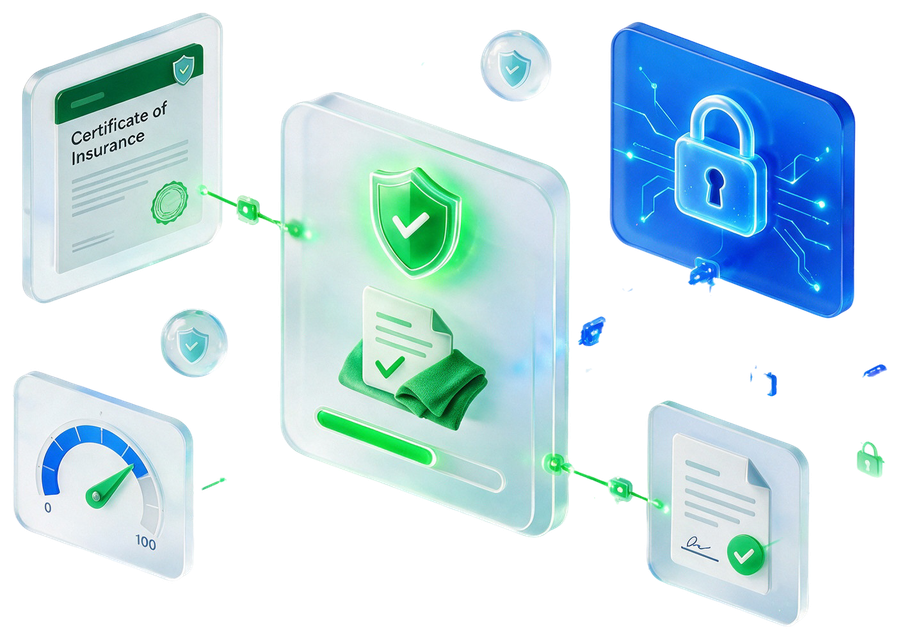
A certificate of insurance (ACORD 25) is strictly an informational document that creates no legal or contractual rights. When a catastrophic loss occurs, underwriters audit the underlying policy endorsements. If your trade partner carries hidden residential exclusions, action-over limitations, or lapsed state licenses, carrier indemnification is denied—leaving the general contractor directly exposed.
Modern commercial cyber insurance policies enforce strict Funds Transfer Fraud warranty clauses requiring documented, dual-channel out-of-band verification prior to wiring draw payments. If a contractor wires funds without satisfying these policy warranties, insurers routinely deny indemnity. Evulta produces time-stamped, audit-ready verification packages that satisfy strict underwriting requirements.
ConstructQC is our continuous automated operational engine designed for project teams to track subcontractor licenses, classification codes, and COI expiration schedules daily. Evulta Independent Cyber Safeguards provides the specialized counterparty risk intelligence, bank account routing authentication, and draw wire fraud defense required for major capital disbursements.
News

Protecting General Contractors from Draw Wire Fraud & Cyber Insurance Denial
Construction draw payments are the single highest-value targets for payment diversion fraud. When a subcontractor's email account is compromised, fraudulent banking details slip into pay applications, diverting hundreds of thousands of dollars. Worse yet, when general contractors turn to their cyber insurance policy for reimbursement, carriers frequently deny coverage under warranty exclusions. Here is how general contractors protect their draw payments and maintain bulletproof cyber insurance defensibility.
In commercial construction, millions of dollars move each month through draw requests, progress billings, and subcontractor disbursements. Fraudsters recognize that general contractors operate in high-velocity, deadline-driven environments where accounting teams process dozens of pay applications simultaneously. This makes construction draw payments the premier target for Business Email Compromise (BEC).
The Draw Wire Fraud Playbook
Most contractors assume cyber attacks target their own internal servers. In reality, the vulnerability almost always lies in a subcontractor's compromised email account:
- The Infiltration: A threat actor compromises a trade subcontractor's email system through phishing or credential stuffing.
- The Silent Observation: The attacker monitors project correspondence, learning billing schedules, project manager names, and outstanding draw balances.
- The Altered Pay Application: Right before a scheduled progress payment, the attacker submits an updated invoice or send an urgent notice stating that the subcontractor has switched banking institutions.
- The Wire Diversion: The contractor's accounting team processes the wire to the new routing number. By the time the legitimate subcontractor calls asking why their payment is missing, the funds have been cleared and laundered offshore.
The "Silent Warranty": Why Cyber Insurance Denies Wire Fraud Claims
When a six-figure wire diversion occurs, general contractors expect their commercial cyber insurance policy to cover the loss. Instead, they often face a devastating denial of coverage.
Modern cyber insurance underwriters insert explicit Funds Transfer Fraud Warranties into policies. These clauses legally mandate that the insured must perform independent, dual-channel, out-of-band verification before modifying payment instructions or wiring funds. If the accounting department accepted an emailed PDF, verified via a phone number listed on that same email, or skipped formal verification due to project deadlines, the carrier cites a breach of policy warranty and rejects the claim entirely.
Independent Counterparty Risk Intelligence
Protecting your firm requires separating operational jobsite monitoring from high-value financial verification. While our flagship ConstructQC platform manages daily subcontractor license verification and COI compliance on site, Evulta provides Independent Counterparty Risk Intelligence for high-stakes financial transactions:
- Verified Bank Routing & Signatory Audits: Independent, out-of-band validation of banking credentials directly with issuing financial institutions—completely segregated from email communications.
- Corporate Entity & Good Standing Cross-Referencing: Verifying that the entity receiving wire funds is the exact legal signatory on the master subcontractor agreement.
- Documented Audit Packages: Time-stamped, defensible verification records structured to satisfy cyber insurance policy warranties and eliminate insurer claim denial.
Dual Protection Across Every Active Project
True risk defense for general contractors requires closing both ends of the exposure spectrum: preventing jobsite liability claims through automated license and COI tracking, and eliminating catastrophic wire diversion through rigorous counterparty intelligence.
Evulta Cyber Safeguards protects General Contractors and developers from draw wire fraud, vendor payment diversion, and cyber insurance claim denial. Downloadable audit packages. Real defensibility.

Why Spreadsheets Fail for Subcontractor License Verification
Manual spreadsheets cannot verify subcontractor licenses, insurance policy limits, or real-time compliance standing. Every project start requires validating state licensing board records, active classifications, and disciplinary history before work begins. Unverified licenses don't just risk state regulatory fines—they trigger immediate commercial liability coverage denial when jobsite claims arise.
The problem is not bad intentions. It is that spreadsheets do not verify anything. They store what someone typed, not what is actually true in the state database or on the insurance carrier's record. And when you have 50, 100, or 500 subcontractors to track, manual entry guarantees that critical compliance gaps fall through the cracks.
The Gap Between Spreadsheets and Reality
A typical subcontractor compliance spreadsheet tracks: name, license number, expiration date, and a checkbox for "COI received." That looks fine on the surface. But here is what the spreadsheet cannot catch:
- Real-time State Board Status: Whether the license is actually active in the issuing state's licensing portal right now.
- Scope vs. Trade Classification: Whether the contractor's specific classification permits the actual trade scope contracted on site.
- Disciplinary & Suspension Records: Whether complaints, disciplinary citations, or license suspensions have been filed against the entity.
- Lapsed Effective Dates: Whether the insurance policy or license expired between onboarding and project execution.
- Carrier Legitimacy: Whether the certificate was issued by an authorized, admitted insurer rather than an unverified paper issuer.
The Coverage Denial Trap
When an unlicensed or incorrectly classified subcontractor is involved in a jobsite incident, commercial general liability insurers audit the subcontractor's credentials during claim investigation. If the subcontractor was operating outside their licensed classification or with a lapsed license, insurers routinely invoke unverified contractor exclusions—denying coverage entirely and leaving the general contractor directly exposed to six- and seven-figure liability.
What Automated Verification Actually Looks Like
Automated subcontractor verification connects directly to authoritative data sources to replace manual spreadsheets with continuous verification pipelines:
- Direct querying of state licensing boards to validate credential status, active classifications, and disciplinary records.
- Automated document parsing that extracts coverage limits, effective dates, and named insured entities from Certificate of Insurance (COI) filings.
- Defect detection logic that flags coverage gaps, missing endorsements, or insufficient policy limits immediately upon submission.
The Deliverable: Audit-Ready Compliance Packages
The deliverable is not a complex, hard-to-maintain dashboard. It is an audit-ready, structured compliance package (available via JSON API or downloadable CSV) containing verified contractor records, verified expiration schedules, and clear defect notices ready for project owners, underwriters, and compliance audits.
Evulta delivers automated subcontractor risk screening, license verification, and COI compliance auditing for general contractors and project owners. Real verification pipelines. Real defensibility.

What a COI Verification Pipeline Actually Catches
Email-based Certificate of Insurance (COI) reviews miss critical coverage gaps and expiration windows. An automated COI verification pipeline extracts and parses coverage limits, policy effective dates, additional insured endorsements, and primary non-contributory wording. It catches coverage defects before subcontractors step on the jobsite, protecting general contractors and owners from uninsured liability.
Every construction project starts the same way: subcontractors email certificates of insurance, someone checks a box, and the project moves forward. Then, when an unexpected claim or jobsite incident occurs, someone opens the file and discovers the certificate was expired, the limits were insufficient, or the named insured did not match the operating entity.
What an Email Inbox Misses
A standard email-inbox review confirms only that a PDF was received. It does not verify whether the certificate satisfies your contractual requirements:
- Mismatched Named Insured: The certificate lists a parent company, DBA, or related entity that is not the legal signatory on your subcontractor agreement.
- Missing Endorsements: Essential endorsements — such as Additional Insured, Waiver of Subrogation, and Primary & Non-Contributory wording — are either omitted or improperly formatted.
- Sublimit Restrictions: Hidden policy exclusions or sublimits that invalidate coverage for the specific work being performed on site.
- Premature Cancellation: Policies cancelled mid-term that remain on file as "active" in an unmonitored spreadsheet.
Endorsement Defects and Claim Repudiation
Insurance carriers defend their balance sheets by aggressively scrutinizing policy endorsements after an incident. If an Additional Insured endorsement lacks Primary & Non-Contributory wording or if the Waiver of Subrogation was omitted, the subcontractor's carrier can legally refuse tender of defense. An automated verification pipeline catches these defects at onboarding, ensuring your coverage is fully defensible before work begins.
Continuous Expiration Auditing
One of the largest exposures general contractors carry is the gap between onboarding and policy renewal. A certificate valid in January may expire in April while the subcontractor is actively pouring concrete on site. An automated verification pipeline audits expiration schedules continuously, triggering renewal workflows well ahead of lapse dates.
Defensible Audit Deliverables
When an insurer, surety underwriter, or project owner conducts a compliance audit, they require concrete proof of coverage continuity. Automated pipelines deliver structured audit trails with time-stamped verification logs, parsed certificate terms, and instant defect alerts.
Evulta replaces manual COI administration with automated parsing, endorsement validation, and continuous expiration auditing. Built for general contractors and developers.